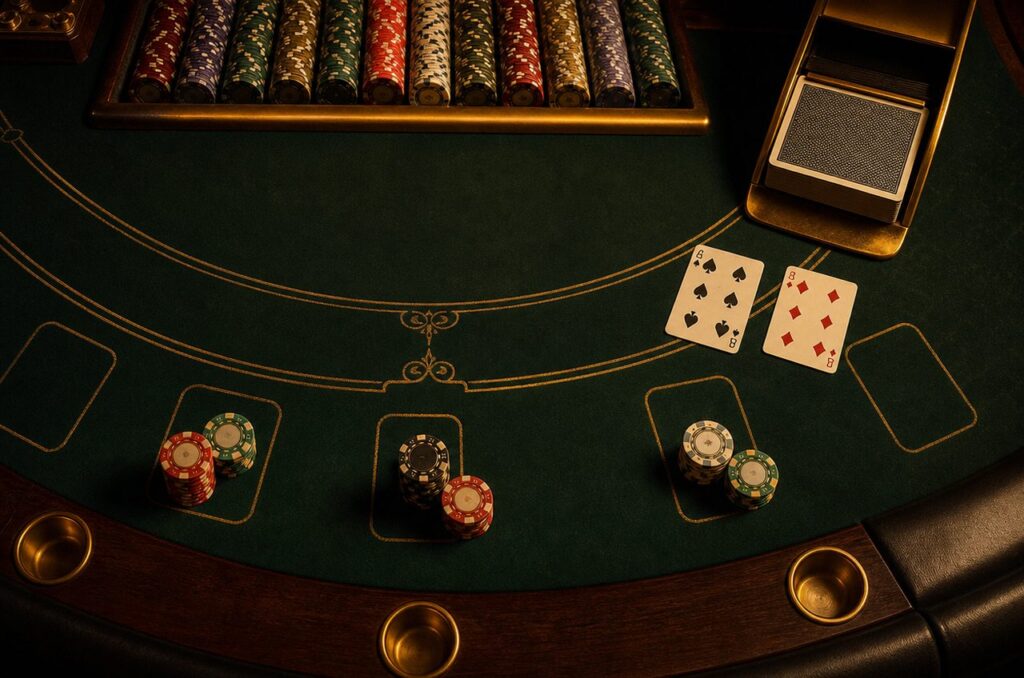
Blackjack is one of the few casino games where skill genuinely affects the outcome: correct play, applied consistently, gets the house edge down to roughly 0.5%, among the lowest of any game on the floor. That just takes basic strategy — no card counting or exotic skill required.
The Basic Goal and Table Setup
The objective is simple: get closer to 21 than the dealer without going over. Cards 2–10 count at face value, face cards count as 10, and an ace counts as 1 or 11. Players compete only against the dealer. Each round deals two cards to each side, one dealer card face down, then the dealer plays fixed rules — usually hitting to 17 or higher, with dealers varying on hitting or standing on a “soft” 17 (an ace-counted-as-11 hand).
Player Decisions: Hit, Stand, Double, Split, Surrender
Depending on the hand, a player may have some or all of these options:
| Decision | What It Does | When It’s Typically Right |
|---|---|---|
| Hit | Take another card | Low hand totals, or when the dealer’s upcard is strong |
| Stand | Keep the current hand, take no more cards | Hand total is already strong relative to the dealer’s upcard |
| Double Down | Double the bet, take exactly one more card | Strong starting totals (e.g. 10 or 11) against a weak dealer upcard |
| Split | Split a pair into two separate hands, matching the bet | Certain pairs (e.g. two 8s, two Aces) against specific dealer upcards |
| Surrender | Forfeit half the bet and end the hand early | Weak starting totals against a very strong dealer upcard, where offered |
Not every table offers surrender, and doubling-after-split rules vary by variant — check the rule set before sitting down.
Basic Strategy and the House Edge
Basic strategy is a mathematically derived chart giving the correct decision for every combination of hand and dealer upcard. It isn’t a betting system and doesn’t guarantee winning sessions — it minimizes the house edge to its lowest point, around 0.5%. Playing by instinct instead routinely pushes the edge up several points, sometimes to 2% or higher, so serious players keep a basic strategy chart on hand.
Card counting is a separate, advanced technique tracking the ratio of high to low cards left in the shoe — it doesn’t meaningfully apply online, since RNG-driven or continuously-shuffled blackjack removes the depleting-shoe pattern it depends on.
See the Full Basic Strategy Chart
The chart below is the actual basic-strategy table that brings the house edge down to roughly 0.5% — the correct play for every hand, worked out in advance. Switch between hard totals, soft totals (any hand with an ace counted as 11), and pairs.
| Your hand | 2 | 3 | 4 | 5 | 6 | 7 | 8 | 9 | 10 | A |
|---|
Assumes a common rule set: 4–8 decks, dealer stands on soft 17, double after split allowed. Different table rules can shift a small number of edge cases near the borderlines above.
Common Blackjack Variants and Rule Differences
“Blackjack” isn’t one fixed rule set — small rule differences shift the house edge meaningfully, even with perfect basic strategy applied:
- Number of decks: Single- and double-deck games favour the player slightly more than six- or eight-deck shoes, all else equal.
- Dealer stands vs. hits soft 17: A dealer who hits soft 17 adds a small edge to the house compared to standing on it.
- Blackjack payout: A natural blackjack traditionally pays 3:2; variants that pay 6:5 instead carry a substantially higher house edge and are generally worth avoiding.
- Doubling and splitting restrictions: Rules that limit doubling to certain totals, or restrict re-splitting, nudge the edge upward.
Checking a table’s rule card before playing confirms you’re not at a worse-than-average version of the game.
Playing Online vs. Live Dealer
Standard online blackjack runs on a certified random number generator with no physical shoe. Live dealer blackjack streams a real dealer and shoe, but the house edge is a function of the rule set, not the format. Confirm the operator is licensed for your province (see the main casino guide), and the same RTP and house edge mechanics apply here as anywhere else. Blackjack’s low edge makes it one of the more favourable games, but the house still wins over time — play within a budget set in advance, and know the responsible gambling tools before you need them.